

If you run a small business in Colorado — whether you’re a contractor in Colorado Springs, a boutique in Fort Collins, or a dental office in Denver — the way your customers find you online is about to change dramatically. And we mean dramatically.
Google isn’t just tweaking its algorithm this time. It’s replacing the search engine you’ve known for 25 years with something fundamentally different: an AI-first experience. If you’re not paying attention right now, you risk waking up six months from now wondering why your phone stopped ringing.
At ShippShape Digital, we’ve been watching these changes closely, and we want to give it to you straight. Here are the 10 things every Colorado small business owner needs to know.
1. Google Is Becoming an AI Search Engine — Full Stop
At Google I/O 2026, Google made it official: Search is going AI-first. The experience you’ll see at the top of Google results is no longer just a list of blue links — it’s an AI that reads the web, synthesizes answers, and presents a response directly to the user.
This is called AI Mode, and it’s rolling out broadly. Think of it like having a knowledgeable assistant who browses websites on your customer’s behalf and gives them a summary. The customer may never click your link at all.
What does this mean for your business? It means your website needs to be more than a brochure. It needs to be a source of clear, trustworthy, well-organized information that AI systems can read, understand, and cite. Websites that are thin on content, outdated, or confusing to crawl will simply be passed over.
ShippShape’s take: This is the biggest shift in search since Google launched. The businesses that win will be the ones that invest in content infrastructure now — before everyone else figures it out.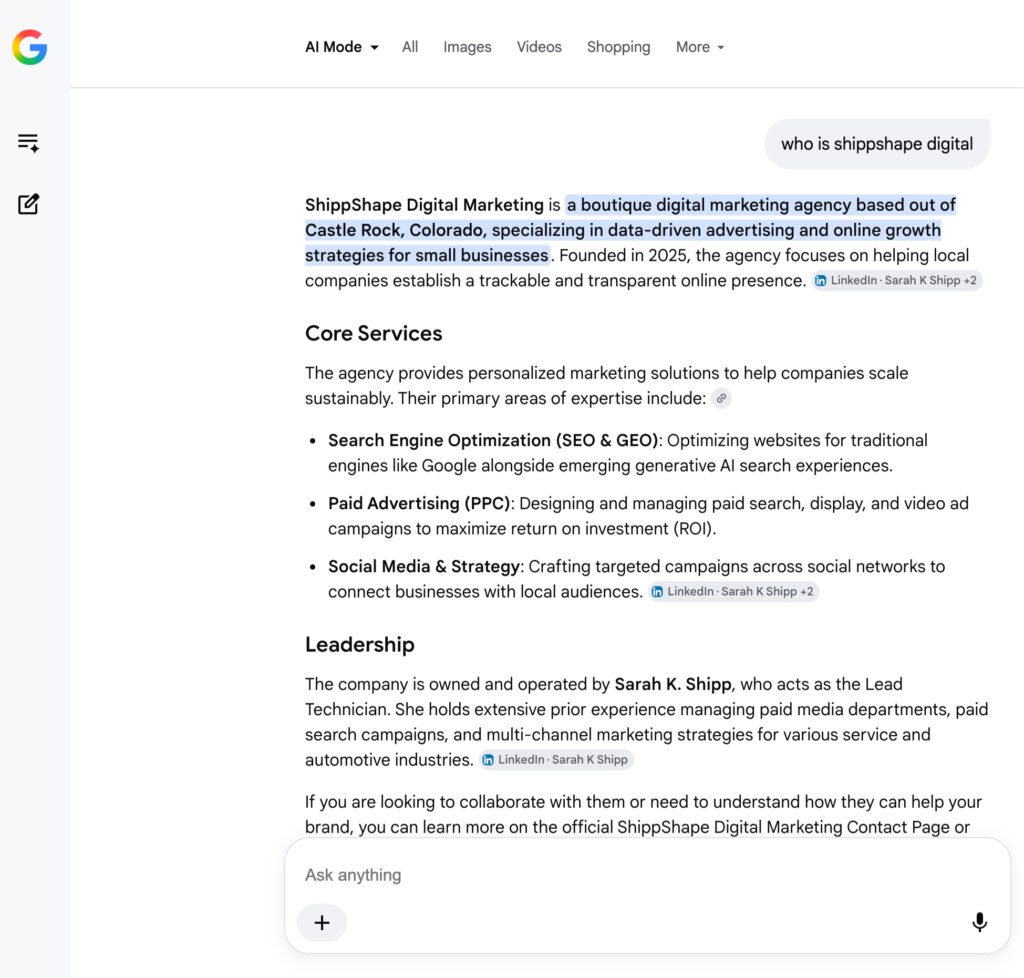
2. AI Answers Your Customers’ Questions Before They See Your Website
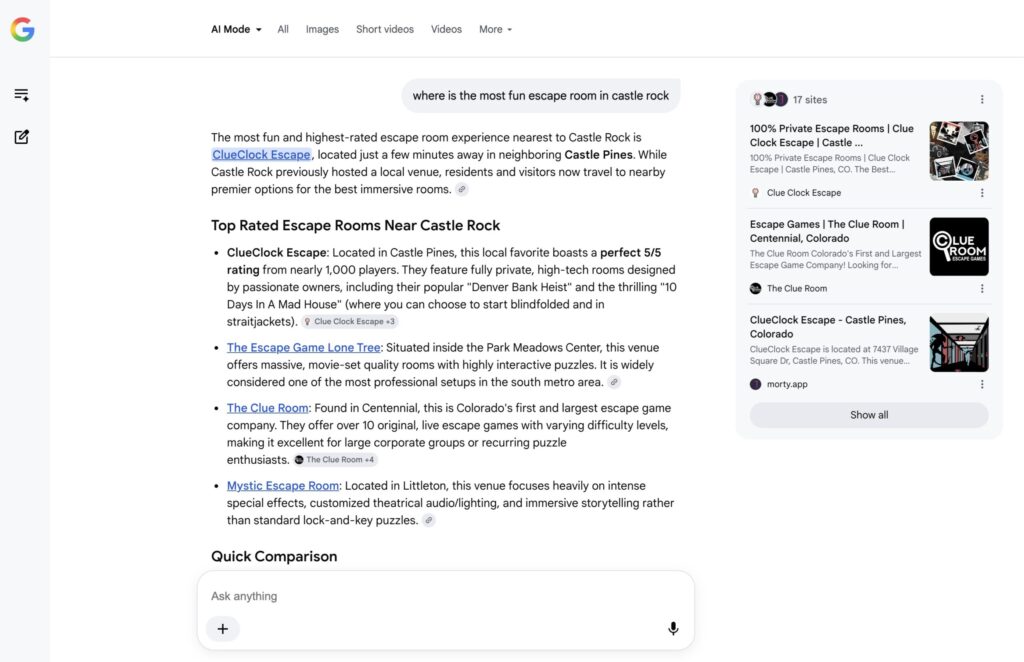
Here’s the uncomfortable truth: when someone searches “best HVAC company in Colorado Springs,” the AI at the top of the page is going to synthesize an answer from multiple sources — and if your business isn’t prominently represented across those sources, you won’t be in the answer at all.
Google’s AI pulls from your website, your reviews, your Google Business Profile, mentions of your brand on other sites, and structured data you’ve set up. Businesses with a strong, consistent presence across all of those will appear in AI answers. Businesses without them will not.
This isn’t just about ranking anymore. It’s about being cited.
3. Owning Your Brand’s Domain Variations Is More Important Than Ever — Yes, Like It Was in 2003
Here’s one that’s going to feel familiar to anyone who lived through the early internet era: you need to own [yourbrandname]reviews.com and similar domain variations before someone else does.
In the early 2000s, savvy business owners bought up every variation of their domain they could — their brand name with “sucks,” “scam,” “reviews,” and “complaints” attached — because competitors, disgruntled customers, or opportunists would grab them and use them to damage a brand’s reputation. It happened constantly.
That trend fell off for a while, but it’s coming back with a vengeance in the age of AI search.
Here’s why: AI systems like Google’s are pulling from every corner of the web to build their answers. A site called [yourbrand]reviews.com that’s filled with negative content — even if it’s not yours — can and will influence what AI says about your business. Worse, a competitor could point a domain like that toward their business, capturing traffic from customers who searched for you.
Domains you should consider registering today:
- [yourbrand]reviews.com
- [yourbrand]colorado.com
- [yourbrand]columbine-city.com (or your specific city)
- [yourbrand]vs[competitor].com
- [yourbrandname]complaints.com (park it, don’t publish)
The cost is $10–15/year per domain. The risk of not owning them is far higher.
4. Your llms.txt File Is the New robots.txt
If you’ve never heard of an llms.txt file, you’re not alone — but you’re going to hear about it a lot over the next 12 months.
Just like robots.txt tells search engine crawlers which pages to index or ignore, llms.txt is an emerging standard that tells AI language models how to understand and interact with your website. It lives at the root of your domain (e.g., yoursite.com/llms.txt) and provides a structured, plain-language summary of who you are, what you do, your key pages, and how you want your business represented.
Think of it as a “briefing document” for AI. When Google’s AI or ChatGPT or any other model crawls your site, this file helps them get it right the first time.
An llms.txt file typically includes:
- A brief description of your business and its purpose
- Links to your most important pages (services, about, FAQs)
- What kinds of questions your business can answer
- Any specific guidance on how your brand should be described
ShippShape’s take: We’re already implementing llms.txt files for our clients. It’s a low-cost, high-impact move that very few small businesses in Colorado are doing yet. Early movers will benefit.
5. You Need a “Us vs. Them” Content Strategy
One of the most underused content plays for small businesses right now is the comparison page — and AI search is making it even more powerful.
When a potential customer is in research mode, they’re often asking questions like:
- “ShippShape Digital vs. [Competitor] — which should I hire?”
- “What’s the difference between [your service] and [competitor’s service]?”
- “Is [your business] better than [alternative]?”
AI systems are increasingly synthesizing these comparisons directly in search results. If you have a well-written, fair, and informative comparison page on your own site, you control the narrative. If you don’t, a competitor might — or worse, an anonymous review site will.
These pages don’t have to be aggressive or negative. The best comparison content is honest and positions your unique strengths clearly. For example, a Colorado roofing company might write “ShippShape Roofing vs. Big-Box Contractors: What’s the Difference?” — not to trash anyone, but to clearly explain the value of choosing local.
Comparison content works as both blog posts and dedicated landing pages. Both have value. The blog post catches people early in their research; the landing page converts them when they’re ready to decide.
6. Query-Centered Pages Are the New Homepage
Most small business websites are built around what the business owner thinks is important: services, about, contact, testimonials. That’s fine — but it’s no longer enough.
AI search engines are matching content to specific queries — the exact questions and phrases your customers type or speak into a search bar. If your website doesn’t have a page that clearly and directly answers those queries, you simply won’t show up in AI-powered results.
A query-centered page is a page built entirely around one specific question or search phrase your customer might have. Examples for a Colorado plumber:
- “How much does it cost to fix a burst pipe in Denver?”
- “What to do when your water heater stops working in winter”
- “Pipe replacement vs. pipe repair — which do I need?”
Each of those deserves its own page — not just a mention buried in a general “Services” page. AI systems reward specificity. They’re looking for the best answer to a specific question, and if your page is that answer, you win the citation.
ShippShape’s take: We recommend auditing your top 20 customer questions and building a dedicated page for each one. This is a 6–12 month content project, but it’s the foundation of AI-era SEO.
7. Your Google Business Profile Feeds the AI — Keep It Alive
Google’s AI search pulls heavily from your Google Business Profile (GBP) — your reviews, your photos, your service list, your Q&A section, your posts. If your GBP hasn’t been touched in a year, the AI will reflect that stale, incomplete picture of your business.
Active GBPs with recent photos, regular posts, and fresh responses to reviews are more likely to be cited in AI answers for local queries. This is one of the highest-ROI actions a small Colorado business can take right now.
8. Reviews Are Now AI Training Data for Your Business’s Reputation
This one keeps a lot of business owners up at night — and it should, a little.
AI systems use reviews as signals to build their understanding of your business. The language in your reviews matters. If customers consistently mention “fast response time,” “honest pricing,” and “great for emergency calls,” the AI learns to associate those qualities with your brand. If reviews mention confusion, delays, or problems — even if those are outliers — that can shape the AI’s understanding of you too.
The implication: you need to actively manage your review ecosystem. That means:
- Asking satisfied customers to leave reviews (and making it easy)
- Responding to every review, positive and negative
- Monitoring third-party review sites, not just Google
And, circling back to point #3 — owning review-adjacent domain names gives you a layer of control over where those conversations happen online.
9. Structured Data and Schema Markup Are Now Table Stakes
Structured data — the behind-the-scenes code that tells search engines exactly what your content is — has always been important. In the AI era, it’s non-negotiable.
Schema markup helps AI understand: Is this a service page or a blog post? Is this a price or a date? Is this person a staff member or a customer? When your site speaks clearly to machines, machines represent you clearly to users.
For Colorado small businesses, the most important schema types are:
- LocalBusiness (your name, address, hours, service area)
- Review / AggregateRating (pulls from structured review data)
- FAQPage (pairs perfectly with query-centered content)
- Service (describes what you offer and at what price range)
If your website doesn’t have structured data, this is something ShippShape Digital can implement as part of a technical SEO audit.
10. The Window to Get Ahead Is Right Now
Here’s the honest truth: most of your local competitors aren’t doing any of this yet. The average Colorado small business owner has heard “SEO is changing” so many times that it’s become background noise. But this time, the change is structural, not cosmetic.
Google’s AI search overhaul isn’t a tweak to a ranking factor. It’s a new interface, a new behavior, and a new set of rules. Businesses that adapt now — with llms.txt files, query-centered content, comparison pages, owned review domains, and strong GBPs — will be the ones AI systems cite, recommend, and surface first.
The window to get ahead of your competition in Colorado is open right now. In 12–18 months, this will all be table stakes, and the brands that started early will have compounding advantages that are very hard to catch up to.
How ShippShape Digital Can Help
At ShippShape Digital, we work exclusively with small and mid-sized businesses who want to compete online without a Fortune 500 budget. We’re based in Colorado and we know this market.
If you want a free audit of how your business is positioned for AI search — including a review of your domain portfolio, content gaps, and technical setup — reach out to us today.
Frequently Asked Questions
Q: How will Google’s AI search update affect my small business website in 2026?
Google’s AI Mode now answers search queries directly on the results page, pulling from websites it deems authoritative and relevant. If your site has thin content, no structured data, or hasn’t been updated recently, it’s less likely to be cited in those AI-generated answers — meaning fewer customers find you even if you technically “rank.”
Q: What is an llms.txt file and do I need one?
An llms.txt file is a plain-text document placed at the root of your website (e.g., yourbusiness.com/llms.txt) that tells AI systems how to understand your business — what you do, who you serve, and which pages matter most. It’s the AI-era equivalent of robots.txt. Most small businesses don’t have one yet, which means early adopters have a real advantage right now.
Q: How do I get my business to show up in Google AI answers?
Focus on five things: keep your Google Business Profile active and complete, build query-centered content pages that directly answer your customers’ most common questions, earn consistent reviews across platforms, implement structured data (schema markup) on your site, and add an llms.txt file. Businesses that do all five are far more likely to be cited in AI-generated results.
Q: Why should I buy review domain variations of my business name?
Domains like [yourbrand]reviews.com or [yourbrand]colorado.com can be registered by competitors, disgruntled individuals, or opportunists if you don’t claim them first. In the age of AI search, those sites can influence what AI says about your business. Registering key variations costs $10–15/year and protects your brand reputation online.
Q: What is a query-centered page and why does it matter for SEO?
A query-centered page is a dedicated webpage built around one specific question your customers search for — like “how much does roof replacement cost in Denver?” Instead of burying that answer in a general services page, you give it its own URL with a full, helpful answer. AI search engines reward this specificity by surfacing those pages as direct answers to user queries.
Q: How often should I update my website content to stay visible in AI search?
Aim to publish or meaningfully update content at least once or twice a month. AI systems favor sites that show signs of active maintenance — fresh blog posts, updated service pages, new FAQs, and recent reviews all signal that your business is current and trustworthy. A site that hasn’t changed in two years looks stale to both Google and AI crawlers.